The Secret to Huge Monstera Leaves: Training Your Tropical Climber
- Dec 11, 2025
- 3 min read
You bought a Monstera for its stunning, iconic leaves but if you just let it sprawl, it will keep producing smaller, less fenestrated foliage. Why? Because the Monstera is a hemiepiphyte a plant that climbs trees to reach the canopy light. To get those big, dramatic leaves, you have to convince your plant that it's successfully climbing!
Here’s your ultimate guide to training your plant for maximum aesthetic impact and health.
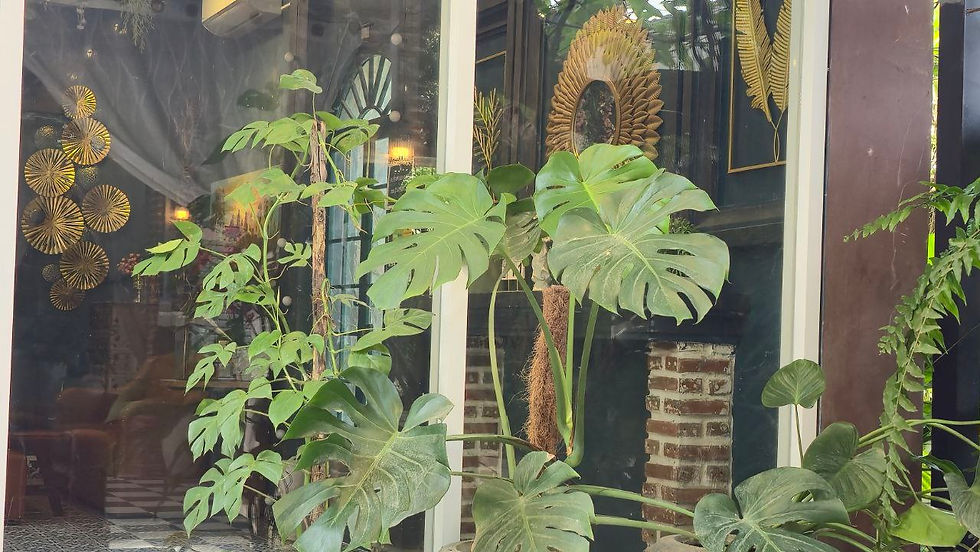
1. The Pro's Choice: Climbing (The Path to Maturity) 🧗
If your goal is to grow a Monstera with dinner-plate-sized, fenestrated leaves, you must train it to climb vertically.
🌿 Why Climbing Works: The "Shade Seeking" Theory
In nature, a Monstera starts on the ground and climbs up a tree trunk. The higher it climbs, the more light it receives. The plant uses its aerial roots to feel the surface it's climbing. When these roots attach firmly to a vertical surface, the plant signals itself: "I have reached the light source, I can now afford to mature!" This maturity results in larger leaves and more fenestrations.
The Essential Tool: The Moss Pole
A dry stake won't cut it. A moss pole (made of sphagnum moss or coco coir) is crucial because:
Attachment: It allows the aerial roots to firmly anchor, activating the maturity signal.
Hydration: It retains moisture, providing extra humidity and nutrients directly to the aerial roots, which the plant prefers.
🛠️ How to Set Up for Success
Placement: Identify the back of your Monstera. This is the side from which the aerial roots emerge and the leaves grow away from. The back MUST face the pole.
Installation: Insert the moss pole deep into the soil during your next repotting (or very carefully into an existing pot). Anchor it firmly.
The Initial Tie-Down: Use soft, stretchy plant ties or Velcro tape (avoid thin string which cuts the stem) to loosely secure the main central stem(s) to the pole.
⚠️ The Golden Rule: Never tie the leaf stems (petioles). Only tie the main, thicker vine/trunk.
Ongoing Misting & Attaching:
Mist the moss pole frequently (daily, if possible).
Gently press any new aerial roots onto the pole's surface. As the plant grows, continue securing the new central growth upwards.
2. The Cascading Look: Trailing (The Bushy Option) 🌱
If you prioritize a lush, cascading look for a shelf or hanging basket (common for Monstera adansonii), trailing is your route.
What to Expect
Size Trade-off: Be aware that this method often leads to smaller leaves and fewer fenestrations, as the plant remains in its "juvenile" or "shade-seeking" phase.
Growth: The vines will become "leggy" as they stretch down for light.
✂️ How to Encourage Fullness
The key to an attractive trailing Monstera is promoting a bushy pot rather than long, thin strands.
Pinch and Prune: When a vine reaches a length you don't like, cut it about a quarter-inch above a leaf node.
This simple act signals the plant to activate dormant buds lower on the stem, resulting in two or more new vines branching out.
Bonus: You now have cuttings for propagation!
Re-root Cuttings: Propagate the pruned cuttings and plant them back into the main pot to increase density and volume instantly.
Manage Aerial Roots: Since they have no surface to attach to, you can either:
Trim them close to the stem (they will regrow).
Gently tuck them back into the soil for extra root support.
🔑 Your Training Checklist
Mistake to Avoid | Correct Action | Result |
Tying the leaf stem (petiole) to the pole. | Tie only the main vine/trunk. | Allows the leaf to move freely and follow the light. |
Letting aerial roots dangle freely. | Mist the pole and press aerial roots onto it. | Activates the 'maturity signal' for bigger leaves. |
Using a plain wooden stake. | Use a moss or coir pole. | Provides moisture and a natural surface for the roots. |
Ignoring the plant's orientation. | Always face the aerial roots (the back) toward the pole. | Ensures the plant is correctly aligned for climbing. |
For iconic size and fenestrations, commit to climbing by providing a moss pole for aerial root attachment. If you prefer a dense, cascading look, accept the trailing size tradeoff and prune often to encourage bushiness.


Comments